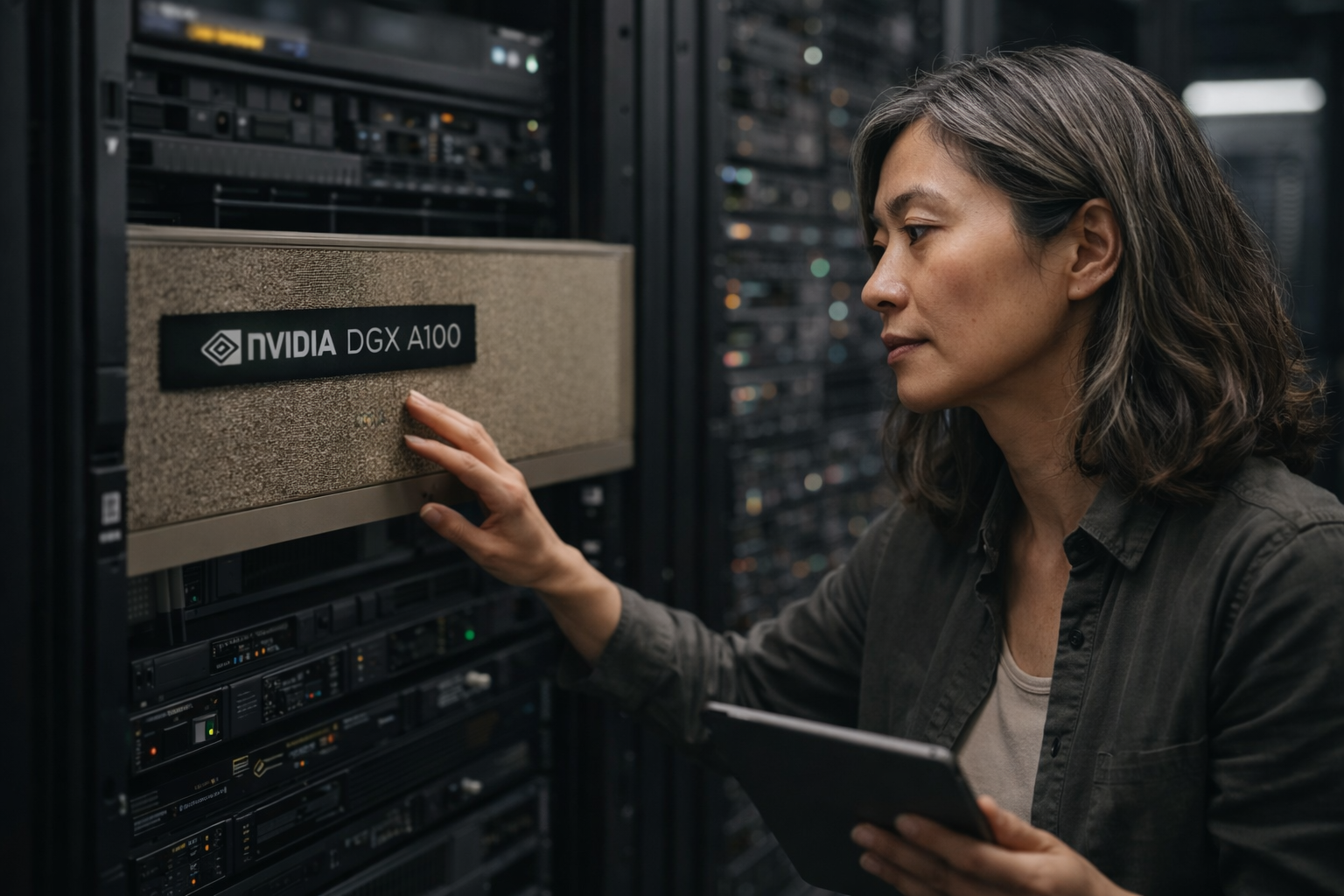

The NVIDIA DGX A100 is NVIDIA’s flagship enterprise AI server, integrating eight A100 Tensor Core GPUs with high-speed NVLink and NVSwitch interconnects into a single, turnkey system designed for large-scale deep learning and HPC workloads. As a dedicated platform for advancing artificial intelligence, the DGX A100 plays a transformative role in modern enterprise infrastructure by unifying training, inference, and analytics workloads for improved performance, efficiency, and scalability. NVIDIA leverages its position as a leader in the world's AI infrastructure, drawing on global expertise and the largest proven grounds in the industry. This universal system represents over a decade of NVIDIA’s investment in purpose-built AI infrastructure, delivering tightly coupled multi-GPU performance that PCIe-based configurations cannot match.
This guide covers DGX A100 architecture, performance benchmarks, enterprise applications, and practical alternatives for teams evaluating their AI infrastructure options. The target audience includes AI researchers, ML engineers, and IT decision-makers who need to determine whether DGX-class systems match their actual workload requirements—or whether more cost-effective cloud GPU solutions better serve their needs. There is already strong interest from early adopters and the industry in the DGX A100, highlighting significant market excitement and attention to its capabilities. The core pain points addressed here are substantial: acquisition costs often reaching millions, 6.5kW power requirements straining data center capacity, and the fundamental question of whether enterprise-grade interconnect justifies the investment for your specific use case.
Direct answer: The NVIDIA DGX A100 is purpose-built for large-scale, tightly coupled multi-GPU training where GPU-to-GPU bandwidth critically impacts performance—but for many AI workloads including fine-tuning, inference, and parallel experiments, it often exceeds actual requirements while straining budgets.
By the end of this guide, you will:
- Understand DGX A100 hardware architecture and interconnect advantages
- Evaluate whether your workloads genuinely require DGX-class infrastructure
- Compare total cost of ownership against cloud GPU alternatives
- Identify practical alternatives delivering competitive performance at lower cost
- Develop a decision framework for AI infrastructure investment
Understanding DGX A100 system architecture
The NVIDIA DGX A100 functions as an integrated AI appliance combining hardware, optimized software, and enterprise support into a single deployment-ready platform. Rather than assembling components from multiple vendors, organizations receive a configured, validated system shipped ready for immediate data center integration. This approach eliminates compatibility concerns while providing direct access to NVIDIA’s full dgx software stack. When configuring and deploying the DGX A100, it is important to use supported and certified cables for both network and power connections to ensure proper functioning, safety, and compliance within complex AI and server infrastructure setups.
For organizations requiring maximum GPU interconnect performance for workloads like trillion-parameter model training, the DGX A100 delivers capabilities that distributed cloud configurations struggle to match. The system’s value proposition centers on eliminating the bottleneck that GPU-to-GPU communication creates in tightly coupled training scenarios. At the hardware level, the motherboard serves as the central component connecting CPUs, GPUs, memory, and other hardware, with key controls and features located directly on the motherboard. The DGX A100’s network ports are set to a default protocol—typically InfiniBand or Ethernet—which can be reconfigured as needed to match specific deployment requirements.
Core hardware components
The system integrates eight NVIDIA A100 Tensor Core GPUs in SXM4 form factor, available with either 40GB HBM2 or 80GB HBM2e memory per GPU. This delivers aggregate GPU memory of 320GB or 640GB respectively, with the 80GB variant providing 2TB/s memory bandwidth per GPU—a 30% increase over the 40GB configuration. Each A100 features 512 third-generation Tensor Cores and 8192 FP32 CUDA Cores, enabling the hardware acceleration that makes modern machine learning training practical at scale.
The NVSwitch fabric provides 600GB/s bidirectional bandwidth between all eight GPUs simultaneously—300GB/s per direction. This interconnect speed dwarfs PCIe Gen4 capabilities by nearly 10X, enabling workloads that move massive data volumes between GPUs without communication becoming the primary bottleneck. Compared to the first generation, the current NVSwitch delivers significantly higher speed and performance, supporting more demanding AI and HPC workloads. For model-parallel training across multiple users or large batch distributed training, this bandwidth directly translates to reduced training time.
Dual 64-core AMD EPYC 7742 CPUs provide 128 cores total at 2.25GHz base frequency with boost to 3.4GHz. System memory starts at 1TB DDR4 across 32 DIMM slots (expandable to 2TB), delivering 204.8GB/s bandwidth per CPU socket. Storage includes 15TB NVMe SSD scratch space (upgradeable to 30TB) plus dual 1.92TB NVMe M.2 SSDs in RAID1 for operating system storage, ensuring data throughput matches the compute resources available.
Interconnect and networking
NVLink 3.0 and NVSwitch architecture form the communication backbone that distinguishes DGX systems from standard server configurations with NVIDIA A100 GPUs. While PCIe-based A100 installations deliver excellent single-GPU performance, multi-GPU scaling efficiency depends heavily on interconnect bandwidth. The DGX A100’s NVSwitch enables all-to-all GPU communication at full speed simultaneously—critical for workloads where GPUs frequently exchange gradient data or model parameters.
External networking leverages eight Mellanox ConnectX-6 VPI adapters, each providing 200Gb/s InfiniBand or Ethernet connectivity. This enables RDMA over InfiniBand or RoCE for cluster fabrics when multiple DGX systems operate together. Upgrades to ConnectX-7 adapters push bandwidth to 400Gb/s per port, relevant for organizations building multi-node clusters where network bandwidth between nodes becomes the new bottleneck.
Compared to standard PCIe-based GPU setups, the interconnect performance difference is substantial: roughly 10X more bandwidth for GPU-to-GPU communication. For workloads that aren’t interconnect-sensitive, this advantage provides little practical benefit. For tightly coupled training across all eight GPUs, it’s the defining capability.
Software stack and management
DGX OS provides an Ubuntu-based operating system optimized for AI workloads, with NVIDIA System Management and Data Center GPU Manager handling monitoring, power management, and resource allocation. Administrators gain visibility into GPU utilization, thermal status, and power consumption across all system resources through integrated management interfaces.
Multi-Instance GPU (nvidia multi instance gpu) technology enables partitioning each A100 into up to seven isolated instances, allowing multiple users to share GPU resources with hardware-level isolation. This addresses the utilization challenge in shared environments where not every workload requires full GPU capacity, though it adds management complexity compared to simply allocating dedicated gpu instances.
Integration with NGC container registry provides access to pre-built, optimized containers for major AI frameworks. These containers deliver performance tuning that would require significant engineering effort to replicate independently, accelerating time-to-productivity for teams deploying new workloads. The following features combine to reduce the operational overhead of managing complex AI infrastructure: pre-validated drivers, optimized framework builds, and documented deployment procedures.
The transition from understanding architecture to evaluating performance requires examining how these specifications translate to actual training throughput for production workloads.
DGX A100 performance and enterprise applications
DGX A100 performance must be evaluated in context of specific workload requirements rather than theoretical peak specifications. The system delivers exceptional results for large-scale AI training scenarios requiring tight GPU coupling, but performance advantages vary depending on whether workloads actually stress the interconnect capabilities that distinguish DGX from simpler configurations.
Understanding when tightly coupled multi-GPU workloads justify DGX investment prevents both over-provisioning (purchasing capabilities you won’t use) and under-provisioning (struggling with infrastructure that bottlenecks legitimate large-scale training).
AI training performance
Benchmark results demonstrate the DGX A100’s strengths in interconnect-sensitive scenarios. Large language model training in TF32 precision achieves 1823 sequences per second compared to 308 sequences per second in FP32 on the previous-generation DGX-1 with V100 GPUs—roughly 6X the training performance for models that leverage Ampere architecture improvements. Computer vision pipelines and scientific computing workloads show similar generational improvements.
Per-GPU specifications include FP64 at 9.7 TFLOPS (19.5 TFLOPS with Tensor Cores), FP32 at 19.5 TFLOPS (156 TFLOPS TF32, up to 312 TFLOPS with sparsity acceleration), and a 40MB L2 cache 7X larger than prior generations. These specifications enable the high performance that makes training trillion-parameter models feasible within reasonable timeframes.
Compared to distributed cloud GPU setups, the DGX A100’s NVSwitch advantage is most pronounced when training requires frequent all-reduce operations across all GPUs. For data-parallel training with infrequent gradient synchronization, cloud gpu instances connected via high-speed ethernet can achieve competitive effective throughput at substantially lower cost.
Enterprise features and reliability
Enterprise support includes hardware warranty, software updates, and professional services for deployment and optimization. Organizations receive a known-good configuration validated by NVIDIA, eliminating the integration challenges that can consume engineering resources when assembling custom solutions. For enterprises with strict compliance requirements, security features and documented configurations simplify audit processes.
Data center integration requires substantial infrastructure: 6.5kW maximum power draw demands appropriate electrical capacity and cooling, while the system’s physical footprint requires standard rack space. These requirements often exceed what smaller organizations have available, pushing them toward cloud alternatives regardless of workload fit.
Compliance, security features, and management capabilities address enterprise requirements that smaller teams may not need. ECC memory, secure boot, and role-based access control serve organizations with formal security policies, while adding complexity for teams prioritizing simplicity.
Total cost of ownership
Purchase price for DGX A100 systems often exceeds $200,000, with fully configured systems reaching substantially higher depending on memory configuration, storage, and networking options. This capital expenditure represents just the beginning of total cost of ownership.
Operational costs include 6.5kW power consumption (roughly $5,700 annually at $0.10/kWh for 24/7 operation), data center space, cooling, and network infrastructure. Staff training and maintenance add ongoing costs that organizations without existing AI infrastructure expertise must factor into their planning.
Support contracts, hardware maintenance, and eventual replacement or upgrade costs complete the total cost picture. Over a five-year operational period, total investment often exceeds initial purchase price significantly—making accurate cost modeling essential before commitment.
This cost structure raises an important question: how does DGX A100 compare to cloud GPU alternatives for teams that need serious compute power without enterprise-scale budgets?
DGX A100 vs cloud GPU alternatives
The decision between on-premise DGX systems and cloud GPU services depends on workload characteristics, budget constraints, and organizational capabilities. Neither option universally dominates—the right choice emerges from honest assessment of actual requirements rather than aspirational infrastructure goals.
Establishing clear criteria for evaluating when DGX-class systems are justified versus when they represent expensive over-provisioning helps organizations avoid both capability gaps and wasted investment.
Workload assessment framework
Tightly coupled vs. embarrassingly parallel workloads: Tightly coupled workloads requiring frequent GPU-to-GPU communication (model parallelism, large-batch synchronized training) benefit most from NVSwitch interconnect. Embarrassingly parallel workloads (hyperparameter sweeps, multiple independent experiments, inference serving) gain little from expensive interconnect and run efficiently on distributed cloud GPUs.
Interconnect sensitivity evaluation: Profile your actual training workloads to measure time spent in communication versus computation. If communication represents less than 20% of total training time, DGX-class interconnect provides limited practical advantage over well-configured cloud infrastructure.
Memory requirements assessment: Workloads requiring shared memory access across multiple GPUs for large model parameters need either DGX-class systems or cloud instances with similar NVLink connectivity. Workloads fitting within single-GPU VRAM can leverage simpler, more cost-effective infrastructure.
Utilization patterns: Organizations with consistent, high GPU utilization may justify capital expenditure on owned infrastructure. Teams with variable workloads, project-based needs, or uncertainty about future requirements typically benefit from cloud flexibility.
Budget constraints and timeline: Available budget and project timeline often determine infrastructure choices more than technical requirements. DGX procurement timelines (weeks to months) and capital approval processes may conflict with project urgency.
Cloud GPU service comparison
Major cloud providers offer A100 instances that approximate DGX capabilities, but quota limitations, regional scarcity, and complex pricing layers make actual cost and availability difficult to predict. Organizations frequently discover that theoretically available cloud resources prove inaccessible when needed or cost substantially more than initial estimates suggested.
Practical alternative: distributed GPU computing
Modern cloud GPU services deliver competitive performance for the majority of AI workloads that get categorized as requiring “enterprise infrastructure.” For fine-tuning, inference, computer vision pipelines, rendering, and parallel experiments, the bottleneck is typically budget, iteration speed, or reliability of access—not theoretical peak performance.
Compute with Hivenet addresses this practical middle ground with RTX 4090 at €0.20/hr and RTX 5090 at €0.40/hr. These rates deliver modern GPU power with predictable, transparent billing. Unlike hyperscaler offerings where actual costs emerge only after usage, the pricing structure enables accurate project budgeting before work begins.
Each GPU provides full, dedicated VRAM with direct access to all resources—no hidden slicing, sharing, or time-multiplexing that reduces effective capacity. For workloads not requiring DGX-class interconnect, this delivers the compute capability teams actually need without paying for interconnect bandwidth they won’t use.
Instant availability eliminates procurement delays and quota negotiations. When you need compute, you book it and start working—a contrast to both DGX purchase processes and cloud provider capacity games that can delay projects by weeks or months.
The useful frame for this decision: “Do I need tightly coupled 8-GPU training with enterprise interconnect, or do I need reliable, affordable GPU power I can scale up and down?” Compute with Hivenet is built for the second case.
Common challenges and solutions
Organizations considering DGX A100 deployment face predictable obstacles. Addressing these challenges before commitment prevents costly surprises and helps teams choose infrastructure that matches their actual situation.
Budget and ROI justification
Many teams struggle to justify seven-figure infrastructure investments for AI projects with uncertain outcomes or timeline.
Solution: Start with cloud GPU services to validate workloads before committing major capital. Running proof-of-concept training on Hivenet GPUs at €0.20-0.40/hr provides real performance data for ROI calculations. If validation confirms DGX-class requirements, you’ve spent hundreds validating the need rather than hundreds of thousands discovering a mismatch. Compare project-based cloud spending against fixed DGX costs over your realistic utilization projections—not optimistic 24/7 assumptions.
Infrastructure and power requirements
DGX A100’s 6.5kW power draw and data center requirements exceed many organizations’ existing infrastructure.
Solution: Evaluate existing data center capacity and calculate upgrade costs before committing to DGX deployment. Power infrastructure upgrades, cooling capacity increases, and facility modifications can add 20-40% to effective system cost. For teams without enterprise data center infrastructure, cloud-first approaches eliminate these concerns entirely while providing equivalent compute access.
Utilization and resource sharing
Purchased DGX systems generate costs whether utilized or idle. Organizations struggle to maintain utilization levels that justify capital investment.
Solution: Implement Multi-Instance GPU technology for multi-user scenarios where different teams can share GPU resources with isolation. However, this adds management overhead and may not match your team structure. Cloud GPU services with granular per-hour billing align costs with actual usage automatically, converting fixed infrastructure costs to variable project expenses that scale with actual need.
Technical expertise and support
Operating DGX systems requires specialized expertise that smaller teams may lack and struggle to develop.
Solution: Cloud GPU providers with responsive support reduce the expertise barrier. Hivenet provides direct access to support when issues arise, rather than requiring internal DGX administration capabilities. Pre-configured environments and managed services accelerate deployment compared to building internal expertise from scratch.
These challenges point toward a consistent pattern: cloud GPU alternatives often provide better fit for organizations without existing enterprise AI infrastructure capabilities.
Conclusion and next steps
The NVIDIA DGX A100 represents a premium solution engineered for specific large-scale AI training scenarios where tightly coupled multi-GPU operation and maximum interconnect bandwidth justify substantial investment in both purchase price and operational infrastructure. For organizations training trillion-parameter models, running production deep learning at scale with enterprise requirements, and maintaining dedicated AI infrastructure teams, DGX systems deliver capabilities that simpler configurations cannot match.
For the majority of teams, however, cloud GPU alternatives provide better alignment between capabilities and actual requirements. The infrastructure overhead, capital commitment, and operational complexity of DGX deployment often exceed what workloads actually demand. Fine-tuning, inference, parallel experiments, computer vision pipelines, and rendering run effectively on modern GPUs without requiring NVSwitch interconnect—making DGX an expensive solution to problems many teams don’t have.
Decision framework: Choose DGX for enterprise-scale, tightly coupled training workloads with dedicated data center infrastructure, full-time utilization projections, and internal expertise to operate and maintain the system. Choose cloud GPU services for project-based work, variable utilization, teams without data center infrastructure, or when budget predictability and access reliability matter more than theoretical peak performance.
Immediate actions:
- Profile current and planned workloads to measure actual interconnect sensitivity
- Calculate total cost of ownership for DGX versus cloud GPU alternatives over realistic time horizons
- Pilot representative workloads on cloud GPU services like Hivenet to establish performance baselines
- Evaluate organizational readiness for DGX operation including infrastructure, expertise, and utilization projections
Further exploration: GPU benchmarking methodologies for your specific workloads, cloud GPU optimization strategies to maximize value from distributed computing, and AI infrastructure cost modeling to support informed investment decisions.
Frequently asked questions (FAQ) about NVIDIA DGX A100
What is the NVIDIA DGX A100 system?
The NVIDIA DGX A100 is a universal AI infrastructure system designed for enterprise-scale AI workloads. It integrates eight NVIDIA A100 Tensor Core GPUs with high-speed NVLink and NVSwitch interconnects, delivering exceptional performance for training, inference, and analytics workloads in a single turnkey platform.
What are the key hardware specifications of the DGX A100?
The DGX A100 comes in two models: the 640GB system with 80GB GPUs totaling 640GB GPU memory, and the 320GB system with 40GB GPUs totaling 320GB GPU memory. It features dual AMD EPYC 7742 CPUs with 128 cores, up to 2TB of system memory, 15TB Gen4 NVMe SSD storage, six NVIDIA NVSwitches for 4.8TB/s bi-directional bandwidth, and Mellanox ConnectX-6 or ConnectX-7 network interfaces supporting up to 200Gbps.
What is Multi-Instance GPU (MIG) technology in DGX A100?
MIG allows each NVIDIA A100 GPU to be partitioned into up to seven separate GPU instances, enabling fine-grained allocation of GPU resources. This supports multiple simultaneous users or workloads on a single system with hardware-level isolation, improving utilization and flexibility.
How does DGX A100's NVSwitch improve performance?
NVSwitch provides full connectivity between all eight GPUs with up to 600GB/s bidirectional bandwidth, enabling extremely fast GPU-to-GPU communication. This high-speed interconnect reduces bottlenecks in tightly coupled multi-GPU training workloads, significantly speeding up large-scale AI model training.
Who should consider investing in a DGX A100 system?
Organizations running large-scale, tightly coupled AI training workloads that require maximum GPU interconnect bandwidth and enterprise-grade infrastructure benefit most from DGX A100. Teams with consistent high GPU utilization and data center capacity to support the system’s power and cooling requirements are ideal candidates.
What are the power and space requirements for DGX A100?
The DGX A100 system requires up to 6.5kW of power and fits into a 6U rackmount form factor. Proper data center infrastructure with adequate electrical capacity and cooling is necessary to support its operation.
How does DGX A100 compare to cloud GPU alternatives?
While DGX A100 delivers unmatched interconnect performance for tightly coupled workloads, cloud GPU services often provide better cost efficiency and flexibility for less interconnect-sensitive tasks such as fine-tuning, inference, and parallel experiments. Cloud options also eliminate the need for upfront capital investment and data center upgrades.
What software stack does DGX A100 use?
DGX A100 runs on DGX OS, an Ubuntu-based operating system optimized for AI workloads. It includes NVIDIA System Management and Data Center GPU Manager for monitoring and managing system resources, and seamless integration with the NVIDIA GPU Cloud (NGC) container registry for optimized AI frameworks.
Can DGX A100 support multiple users simultaneously?
Yes, with NVIDIA Multi-Instance GPU technology, DGX A100 can create multiple isolated GPU instances, allowing multiple users or jobs to run concurrently without impacting each other’s performance.
What kind of support and warranty does NVIDIA provide for DGX A100?
NVIDIA offers a standard 3-year warranty with options to extend support to 5 years. Enterprise support services include hardware maintenance, software updates, and access to NVIDIA AI experts for deployment and optimization assistance.
How does DGX A100 handle data storage?
DGX A100 includes high-speed NVMe SSD storage, typically 15TB of Gen4 NVMe for scratch space and dual 1.92TB NVMe M.2 SSDs configured in RAID1 for operating system storage, ensuring rapid data throughput aligned with compute performance.
What networking options are available on the DGX A100?
The system supports Mellanox ConnectX-6 or ConnectX-7 adapters providing up to 200Gbps InfiniBand or Ethernet connectivity. This enables high-throughput, low-latency networking essential for multi-node cluster environments.
Is DGX A100 suitable for AI workloads beyond training?
Yes, DGX A100 is designed as a universal system capable of handling AI training, inference, and analytics workloads, consolidating them into a single infrastructure platform.
How does DGX A100 support AI innovation?
By delivering unprecedented compute density, flexibility with Multi-Instance GPU technology, and optimized software stacks, DGX A100 accelerates AI innovation across enterprises by enabling faster model development and deployment at scale.
Where can I get more details or contact NVIDIA for DGX A100?
For detailed specifications, pricing, and support inquiries, you can contact NVIDIA Enterprise Support or authorized NVIDIA partners. They provide expert guidance tailored to your AI infrastructure needs.
